For example, if the input string is “00100101”, then there are three substrings “1001”, “100101” and “101”.
Ans
a) Count the number of 1’s. Let the count of 1’s be m.
b) Return m(m-1)/2
For example, if the input string is “00100101”, then there are three substrings “1001”, “100101” and “101”.
Ans
a) Count the number of 1’s. Let the count of 1’s be m.
b) Return m(m-1)/2
               1
             1   1
             2   1
          1  2   1   1
       1  1  1   2   2   1

What is the next line?
Answer
LZ algorithm
Next line is pairs (count, digit) for sequence of digits in previous line.
3 1 2 2 1 1
It is not possible to solve an instance of 8 puzzle if number of inversions is odd in the input state.
What is inversion?
A pair of tiles form an inversion if the the values on tiles are in reverse order of their appearance in goal state. For example, the following instance of 8 puzzle has two inversions, (8, 6) and (8, 7).
   1   2   3
   4   _   5
   8   6   7
int getInvCount(int arr[])
{
    int inv_count = 0;
    for (int i = 0; i < 9 - 1; i++)
        for (int j = i+1; j < 9; j++)
             // Value 0 is used for empty space
             if (arr[j] && arr[i] &&  arr[i] > arr[j])
                  inv_count++;
    return inv_count;
}

bool isSolvable(int puzzle[3][3])
{
    // Count inversions in given 8 puzzle
    int invCount = getInvCount((int *)puzzle);

    // return true if inversion count is even.
    return (invCount%2 == 0);
}
str = '1234'

str - '0' = [1 2 3 4]

When you use arithmetic operators with strings, strings is cast as doubles, which converts a string to ascii values,
Thus, subtraction will work just fine, though addition will give weird results
ANSWER
Sort the array. The largest numbers should be in the least significant positions, so build up your two integers by alternating from the two arrays.
E.g. 1 3 5 7 8 9 => 1 and 3, then 15 and 37, then 158 and 379. 0 is a special case, if not allowed to use that as a leading digit then have to use it as the second digit.
Try adding two numbers, you would find all that matters is the order of magnitude of a digit and not which of the two numbers that a digit belongs. (e.g. 178+29 = 128+79 = 179+28 = 129+78)

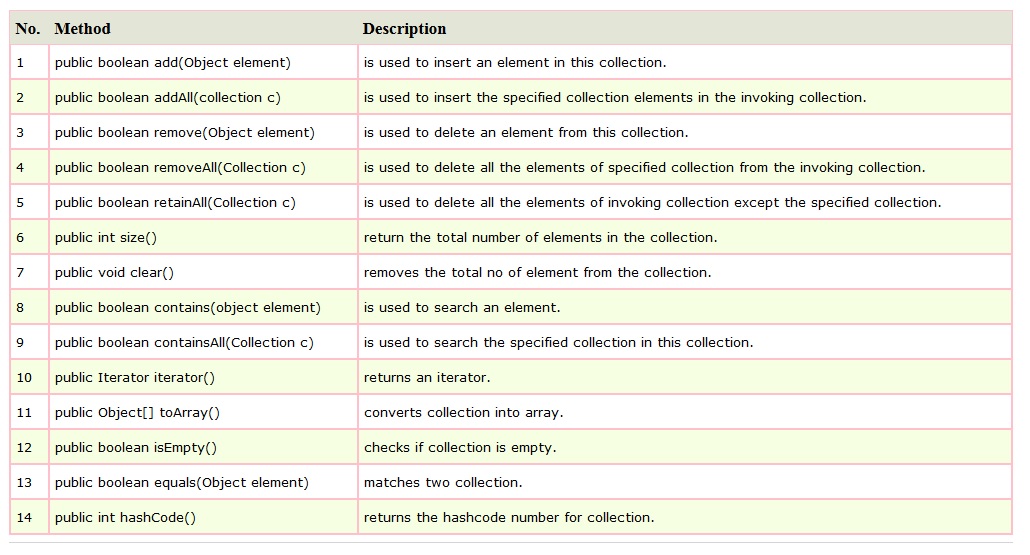
| Iterator interface provides the facility of iterating the elements in forward direction only. |
There are only three methods in the Iterator interface. They are:
Given a set of n nuts of different sizes and n bolts of different sizes. There is a one-one mapping between nuts and bolts. Match nuts and bolts efficiently.
Constraint: Comparison of a nut to another nut or a bolt to another bolt is not allowed. It means nut can only be compared with bolt and bolt can only be compared with nut to see which one is bigger/smaller.
Other way of asking this problem is, given a box with locks and keys where one lock can be opened by one key in the box. We need to match the pair.
Logic
As we apply partitioning on nuts and bolts both so the total time complexity will be Θ(2*nlogn) = Θ(nlogn) on average.
CODE
private static void matchPairs(char[] nuts, char[] bolts, int low, int high) { if (low < high) { // Choose last character of bolts array for nuts partition. int pivot = partition(nuts, low, high, bolts[high]); // Now using the partition of nuts choose that for bolts partition(bolts, low, high, nuts[pivot]); // Recur for [low...pivot-1] & [pivot+1...high] for nuts and bolts array. matchPairs(nuts, bolts, low, pivot-1); matchPairs(nuts, bolts, pivot+1, high); } }hasArrayTwoCandidates (A[], ar_size, sum)
1) Sort the array in non-decreasing order.
2) Initialize two index variables to find the candidate elements in the sorted array.
(a) Initialize first to the leftmost index: l = 0
(b) Initialize second the rightmost index: r = ar_size-1
3) Loop while l < r.
(a) If (A[l] + A[r] == sum) then return 1
(b) Else if( A[l] + A[r] < sum ) then l++
(c) Else r--
4) No candidates in whole array - return 0
Given an n x n matrix, where every row and column is sorted in increasing order. Given a number x, how to decide whether this x is in the matrix. The designed algorithm should have linear time complexity.
1) Start with top right element
2) Loop: compare this element e with x
i) if they are equal then return its position
ii) e < x then move it to down (if out of bound of matrix then break return false)
iii) e > x then move it to left (if out of bound of matrix then break return false)
3) repeat the i), ii) and iii) till you find element or returned false
If you're only interested in the keys, you can iterate through the keySet() of the map:
Map<String, Object> map = ...;

for (String key : map.keySet()) {
    // ...
}

If you only need the values, use values():
for (Object value : map.values()) {
    // ...
}
Finally, if you want both the key and value, use entrySet():
for (Map.Entry<String, Object> entry : map.entrySet()) {
    String key = entry.getKey();
    Object value = entry.getValue();
    // ...
}
 Learn By Coding